ICPO Foundation >> Research Support >> Research Grants

Illustration of a few projects funded by ICPO Research Grants

Due to the large number of research grant applications currently under review by our Scientific Advisory Board, no new application is possible, this until further notice.
ARCHE – An AI-driven Curation and Harmonization Engine for Structuring Multimodal Theranostics Data
Ludwig Maximilian University Hospital, Munich, Germany - Prof. Lalith Kumar Shiyam Sundar
The project proposes an AI-native harmonization engine specifically designed for Theranostics data, implemented within a single high-volume clinical center, and developed on a large, fully and readily accessible real-world cohort of more than 1,000 patient datasets, including different radioisotopes. This creates a unique opportunity to move from concept to implementation, and to demonstrate how structured, multimodal data can become a shared asset for the Theranostics community.

AI-powered global platform for radiopharmaceutical trials
WARMTH (World Association of Radiopharmaceutical and Molecular Therapy) and Ancora.ai collaborated to develop this novel tool.
The Radiopharmaceutical Trial Finder combines Ancora.ai’s advanced technology for clinical trial data processing with scientific input from WARMTH, ICPO Foundation, and top radiopharmaceutical scientific experts from across the world. Within minutes, patients and their clinicians can find relevant radiopharmaceutical trials for their specific situation. Additionally, researchers and practitioners can easily follow the current landscape of trials while also following emerging research trends to identify opportunities for global collaboration. By bringing together patients, clinicians and researchers, this pioneering platform fosters scientific collaboration and accelerates research to bring innovative treatments faster to market.

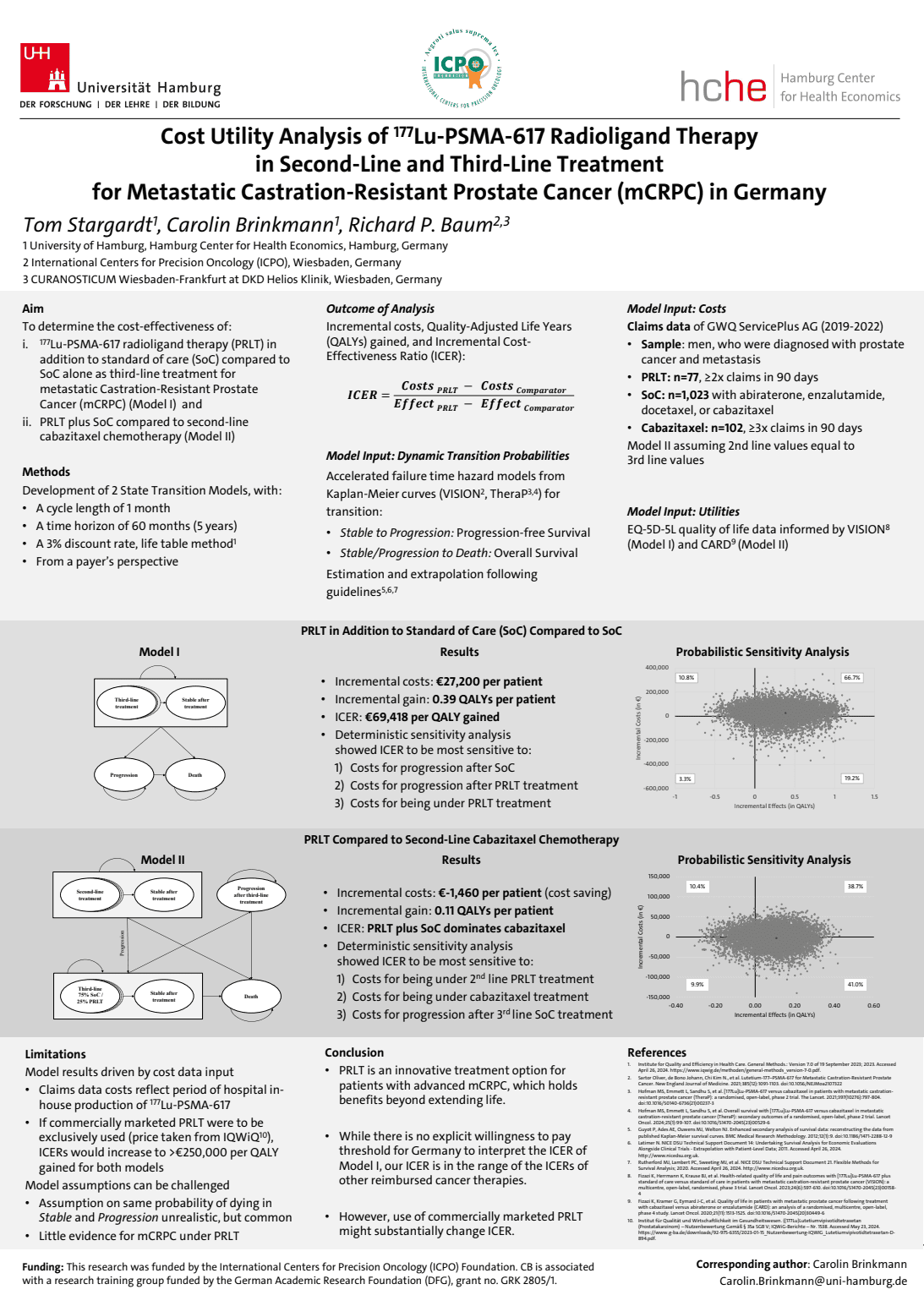
Cost-Utility Analysis of 177Lu–PSMA-617 Radioligand Therapy in Second-Line and Third-Line Treatment for Metastatic Castration-Resistant Prostate Cancer(mCRPC) in Germany
Hamburg Center for Health Economics – Prof. Dr. Tom Stargardt & Carolin Brinkmann
This study aims to assess the cost-effectiveness of 177Lu-PSMA-617 radioligand therapy (PRLT) for patients with metastatic castration-resistant prostate cancer (mCRPC). Two specific comparisons will be made: Model I compares PRLT plus standard of care (SoC) with SoC alone as a third-line treatment. Model II compares PRLT plus SoC with second-line cabazitaxel chemotherapy, assuming second-line values are equivalent to those of third-line treatments.

Investigation of 161Tb-based PSMA radioligand therapy: efficacy and safety evaluation in clinically relevant mouse models
PSI Paul Scherrer Institut – Dr. Korbinian Krieger and PhD Cristina Müller
Targeted radionuclide therapy delivers ionizing radiation to tumor cells through the accumulation of intravenously injected radiopharmaceuticals. In the case of metastatic castration-resistant prostate cancer, the currently used agent [177Lu]Lu-PSMA-617 is limited by side effects from the accumulation of radioligand in non-tumor tissues and the moderate biological efficacy of 177Lu. To address these shortcomings, [161Tb]Tb-SibuDAB was developed at ETH Zurich/Paul Scherrer Institute. An added albumin-binding moiety enhanced the blood circulation time and, hence, increased the tumor dose while reducing off-target accumulation. Open questions remain as to the overall tolerability of [161Tb]Tb-SibuDAB and its effectiveness in neutralizing bone metastases. The objective is to conduct a tolerability and efficacy study of [161Tb]Tb-SibuDAB in two different rodent models. If tolerability and efficacy can be ascertained, [161Tb]Tb-SibuDAB will be introduced into clinical use in Switzerland in a phase I trial.

Development of 18F-labeled radioligands for PET imaging of PD-L1 positive tumors
Helmholtz-Zentrum Dresden – Prof. Dr. Klaus Kopka & Dr. Sven Stadlbauer
Immune checkpoint inhibitor (ICI) therapy targeting the PD-1/PD-L1 axis is a very promising treatment option for cancer therapy. However, since only ca. 30% of patients respond to ICI therapy, a diagnostic tool is highly sought after to identify those patients prior to therapy who are likely to respond. Positron emission tomography / computer tomography (PET/CT) allows to address the temporospatial heterogeneity of PD-L1 dysregulation and thus would be an ideal tool to answer the likeliness of a therapy response. Therefore, this project aims on developing a 18F-PET tracer based on the highly water-soluble small molecule radioligands previously reported by our group for 64Cu labelling.

FAP Theranostics- Cancer-Associated Fibroblasts (CAFs)-Targeted Imaging and Therapy and Combination with Immunotherapy or Chemotherapy (including also other radioligands)
Dr. Jingjing Zhang & Vivianne Jakobsson
This project aims to utilize 177Lu and 225Ac conjugated with FAP for targeted imaging and therapy in solid tumors, focusing on cancer-associated fibroblasts (CAFs). Additionally, it seeks to investigate the synergistic effects of PD-L1 immunotherapy or chemotherapy with FAP-targeted radionuclide therapy, aiming to enhance treatment efficacy beyond single modalities. Preclinical tests will explore various radiopharmaceuticals for PTRT targets and identify immune targets that may improve efficacy through better crosstalk with RLT. Moreover, the project aims to address cases of alpha/beta irresponsive and PD-1/PD-L1 inhibitor-resistant patients to develop more effective treatments.

menuchevron-downarrow-upcross-circle